Your loft is currently a thermal bridge. Heat rises. It hits your ceiling. If your insulation is thin, that heat keeps going. It warms the spiders in your attic. Then it disappears through your roof tiles. You are paying to heat the neighborhood.
This isn't just a comfort issue. It is a financial leak. Most UK homes have some insulation. Most of it is insufficient. The current gold standard is 270mm loft insulation. It is the specific depth required to meet modern standards.
Many homeowners view insulation as a "someday" project. They see it as a cost. We see it as an investment with a rapid recovery rate. In many specific scenarios, the math proves it pays for itself in months, not years.
The Physics of the "Magic" 270mm
Heat moves in three ways: conduction, convection, and radiation. Your loft deals mostly with conduction and convection. Mineral wool or glass fiber traps air in tiny pockets. This air acts as a barrier.
If you have 100mm of insulation, you have a decent barrier. But it isn't enough to stop the pressure of rising heat. Heat is aggressive. It pushes through thin layers.
When you reach 270mm loft insulation, the thermal resistance (R-value) hits a tipping point. This thickness is the "sweet spot" where the cost of the material matches the maximum efficiency of the thermal break. Adding more than 270mm offers diminishing returns. Having less means you are still losing significant energy.

Part L and the Law of Efficiency
Building regulations aren't just red tape. They are designed to lower the nation's carbon footprint. Regulations & Building Standards in the UK have evolved. Part L of the Building Regulations focuses on the conservation of fuel and power.
For new builds and significant renovations, meeting the U-value (thermal transmittance) requirements is mandatory. For a loft, a U-value of 0.16 W/m²K is the target. Achieving this almost always requires a minimum of 270mm of mineral wool.
If you are planning to sell or rent your property, these standards matter. A home that fails to meet modern energy saving upgrades for lofts will struggle on the market. Buyers are savvy. They check the EPC rating first.
The Financial Logic: Months vs. Years
Let’s look at the numbers. The average cost for a professional loft top-up varies. However, the energy savings are consistent.
A detached house can save upwards of £590 per year by upgrading to 270mm. A semi-detached home might save £350. At first glance, a £900 installation looks like a 3-year payback.
But here is where the "months, not years" logic applies:
- The Grant Factor: Through schemes like the Great British Insulation Scheme (GBIS), many homeowners qualify for partial or full funding. If a grant covers 70% of your cost, your personal outlay is recovered in a single winter season.
- Monthly Cash Flow: Stop looking at the "total cost." Look at your monthly utility bill. If your bill drops by £40 a month and you financed the installation for £30 a month, you are cash-positive from Month One.
- Preventative ROI: Proper insulation prevents "thermal shock" to your roof timbers. It reduces the risk of damp and mold. One damp remediation job can cost £2,000. Avoiding that cost makes the insulation "pay for itself" the moment the first heavy rain hits.

The EPC 'C' Roadmap
The UK government has set ambitious targets for residential energy efficiency. Landlords, in particular, are feeling the pressure. Moving a property from an EPC rating of 'E' or 'D' up to a 'C' is becoming essential for legal compliance and mortgage eligibility.
Loft insulation is the "low-hanging fruit" of the EPC 'C' Roadmap (Landlord & Seller Focus). It is cheaper than heat pumps. It is less invasive than internal wall insulation. It provides the biggest jump in points for the lowest capital expenditure.
You can learn more about how this impacts your property value in our Property Sales & Investment section.
Why "Loft Insulation Depth Standards" Matter
Many people think they are "sorted" because they see yellow glass fiber between their joists. Usually, that layer is only 100mm deep: the standard from the 1980s.
Insulation also degrades. It settles over time. It gets squashed by old suitcases or Christmas decorations. Once insulation is compressed, it loses its R-value. It is no longer trapping air; it is just a dense mat.
Upgrading to the modern loft insulation depth standards involves more than just throwing more wool down. It requires:
- Cross-layering: Placing the new layer perpendicular to the joists to eliminate "cold bridges."
- Eave Ventilation: Ensuring that while the loft is warm, it can still "breathe" to prevent condensation.
- Pipe and Tank Lagging: Protecting your plumbing now that the loft space will be significantly colder.

Eco-Friendly & Sustainable Living
Beyond the bank account, there is the planet. A properly insulated home reduces carbon emissions by up to 0.6 tonnes per year. This is one of the most significant things a single household can do to combat climate change.
Choosing sustainable materials, such as recycled glass wool or sheep’s wool, further enhances your home's "green" credentials. You can explore these options in our Eco-Friendly & Sustainable Living category.
The Storage Trap: Don't Squash Your ROI
The biggest mistake homeowners make is boarding directly over 270mm of insulation. If you screw floorboards directly into your joists, you squash the material. You effectively turn 270mm of protection back into 100mm of useless matting.
To maintain your ROI, you must use loft legs or stilts. These raised systems allow the full depth of the insulation to sit undisturbed while providing a sturdy platform for storage.
If you are worried about how to manage your storage space, check out our Practical Loft Solutions & Maintenance guides.

Summer ROI: The Forgotten Benefit
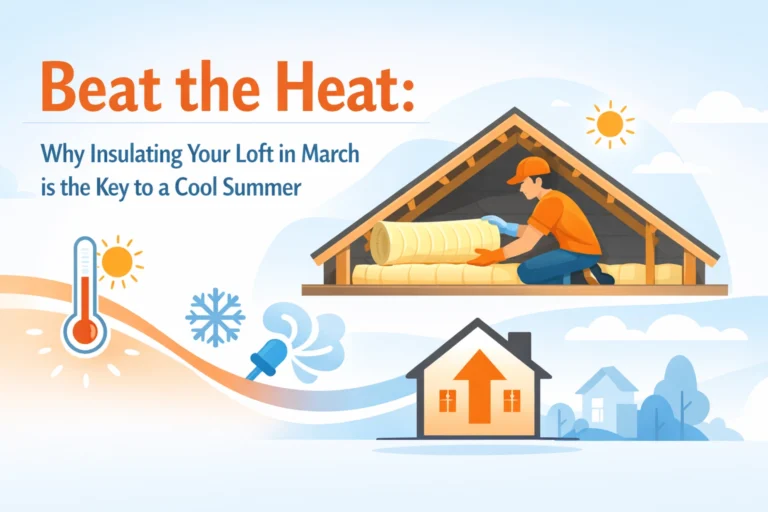
Most people think about insulation in December. They should think about it in July. 270mm of insulation works both ways. It stops heat from leaving in the winter, but it also stops the sun’s radiation from baking your bedrooms in the summer.
A house with poor loft insulation becomes an oven during a UK heatwave. This leads to sleepless nights and the high cost of running electric fans or air conditioning units. The "months" where your insulation pays you back include the summer months, too.
Health, Air Quality & Safety
Poorly insulated homes are prone to the "stack effect." This is where warm air escapes out the top, pulling cold, damp air in through the ground floor. This creates drafts and can circulate allergens.
By sealing the "lid" of your home with professional-grade insulation, you stabilize the indoor climate. This reduces the strain on your respiratory system and creates a healthier living environment. For more on this, visit our Health, Air Quality & Safety section.

Final Thoughts
The math is clear. The physics are undeniable. 270mm loft insulation is not a luxury; it is a fundamental requirement for a modern UK home. Whether you are looking to slash your monthly bills, hit the EPC 'C' target, or simply stay warm, the return on investment is immediate.
Stop heating the sky. Secure your home’s thermal envelope and start seeing the savings in your very next energy bill.
Ready to see how much you could save?
Book Your Free Consultation or Get A Quote today. We’ll help you navigate the grants and technical standards to ensure your loft is working for you, not against you.