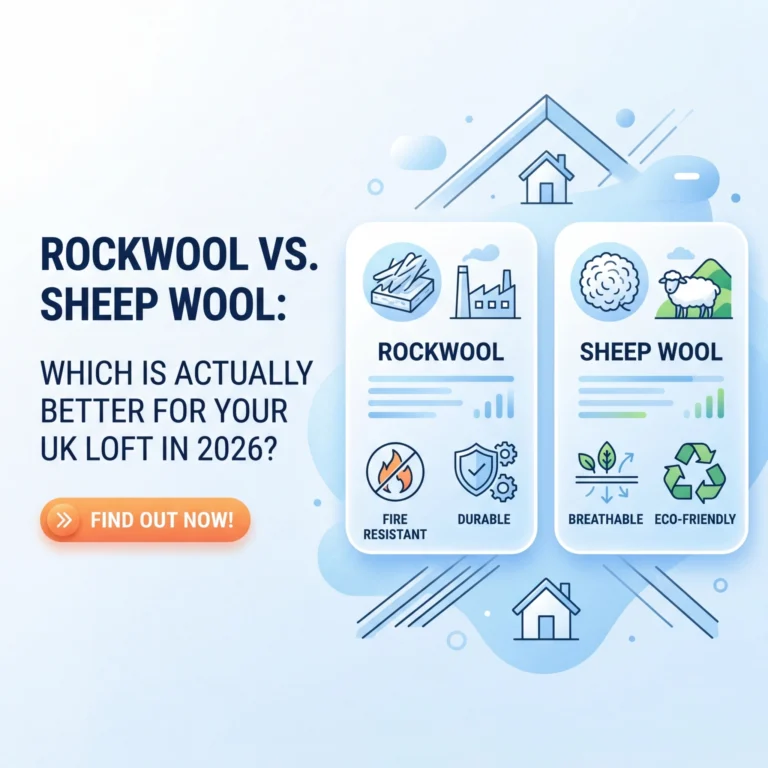
Category: Material Guides & Comparisons
Choosing loft insulation in 2026 feels overwhelming. Three materials dominate the market. Each has passionate supporters. And each comes with very different price tags.
Rockwool. Multifoil. Spray foam. Which one actually makes sense for your home and your wallet?
This guide breaks down the real costs, thermal performance, and payback periods. No fluff. Just the facts you need to make a smart decision.
The Three Contenders: A Quick Overview
Before diving into numbers, here’s what you’re working with.
Rockwool (Mineral Wool)
Rockwool is the traditional choice. It’s made from volcanic rock spun into dense, fibrous batts or rolls.
- Excellent fire resistance (withstands temperatures up to 1,000°C)
- Great soundproofing properties
- Easy to handle for DIY or professional installation
- Recyclable and environmentally friendly
It’s been insulating UK homes for decades. There’s a reason it remains popular.
Multifoil Insulation
Multifoil is the modern alternative. Thin layers of foil and wadding work together to reflect heat back into your home.
- Extremely space-efficient (typically 25–40mm thick)
- Lightweight and easy to fit between rafters
- Reflective technology rather than bulk
- Ideal for loft conversions and rooms in roofs
It solves a problem traditional insulation can’t: saving space while delivering performance.
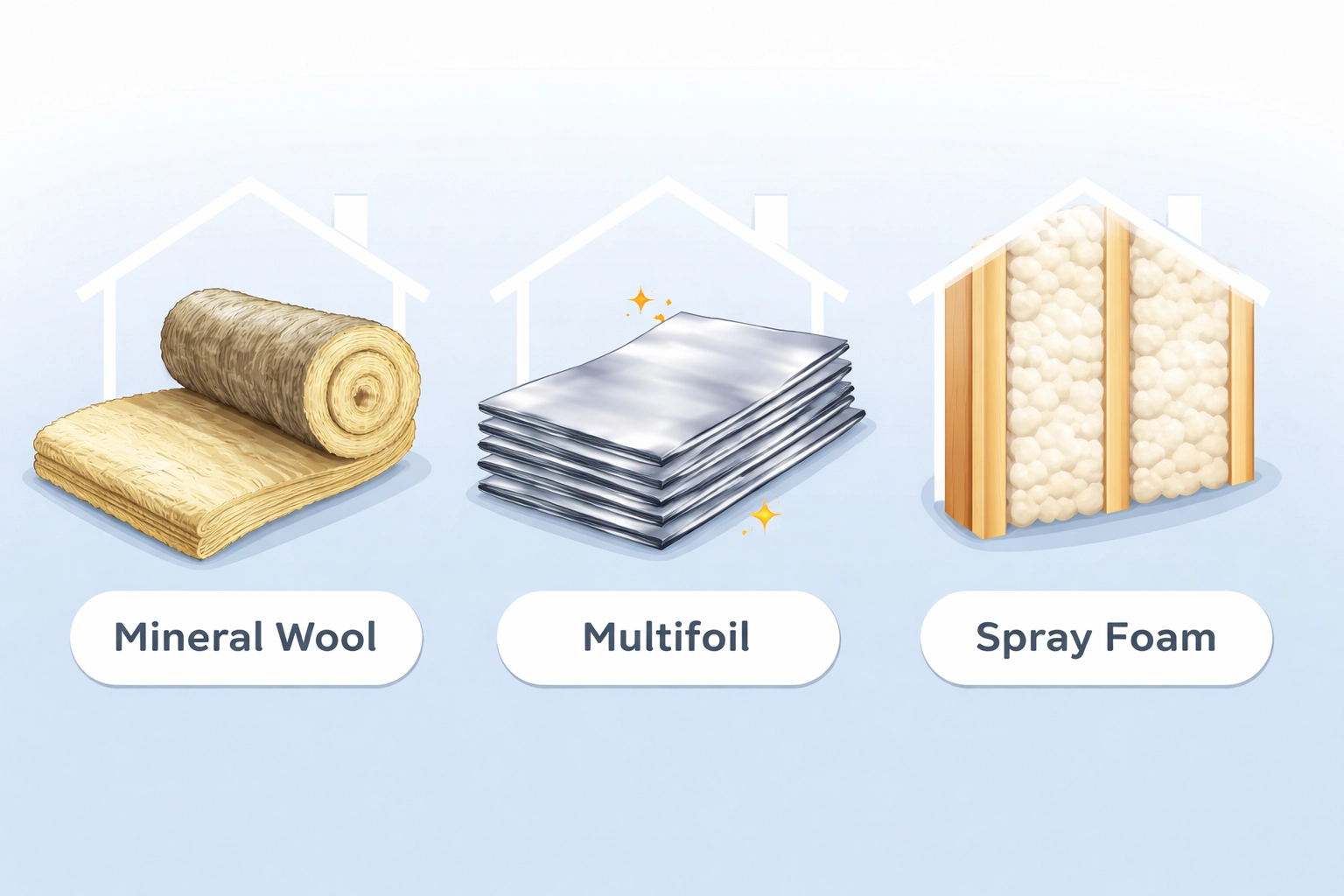
Spray Foam Insulation
Spray foam expands on contact to fill every gap and cavity. It creates an airtight seal across your roof space.
- Highest R-value per inch of any common insulation
- Complete air sealing eliminates drafts
- Long lifespan (50+ years when installed correctly)
- Requires professional installation only
Sounds perfect, right? Not quite. There’s a significant catch we’ll cover shortly.
Installation Costs: What You’ll Actually Pay
Let’s talk money. This is where the three materials diverge significantly.
Rockwool Costs
Rockwool is the most affordable option upfront.
| Coverage | Typical Cost |
|---|---|
| Per square metre | £5–£12 |
| Average UK loft (50m²) | £250–£600 |
Professional installation adds roughly £200–£400 to the total. Many homeowners choose DIY to save even more.
Best for: Budget-conscious upgrades and top-up jobs on existing insulation.
Multifoil Costs
Here’s where it gets interesting. Multifoil currently costs roughly double that of Rockwool.
| Coverage | Typical Cost |
|---|---|
| Per square metre | £10–£25 |
| Average UK loft (50m²) | £500–£1,250 |
Installation typically requires professional fitting, especially for rafter applications. Add £300–£600 for labour.
Why the premium? You’re paying for space savings and advanced technology. In a loft conversion, that extra headroom is worth thousands.
Spray Foam Costs
Spray foam sits at the top of the price range.
| Coverage | Typical Cost |
|---|---|
| Per square metre | £20–£50 |
| Average UK loft (50m²) | £1,000–£2,500 |
Professional installation is mandatory. The equipment and expertise required make this a specialist job.
The hidden cost: Mortgage problems. Many UK lenders refuse properties with spray foam insulation. Removal costs can reach £3,000–£10,000. Read more about why mortgage lenders reject spray foam.

Thermal Performance: The Numbers That Matter
Cost means nothing if the insulation doesn’t perform. Here’s how each material stacks up.
R-Values Compared
R-value measures thermal resistance. Higher numbers mean better insulation.
| Material | R-Value Per Inch |
|---|---|
| Closed-cell spray foam | 6.0–8.0 |
| Open-cell spray foam | 3.5–3.8 |
| Multifoil | 3.5–5.0 (effective) |
| Rockwool | 3.0–4.2 |
Spray foam wins on raw numbers. But here’s the thing: you rarely compare inch-for-inch in real-world applications.
Real-World Performance
Rockwool achieves excellent thermal performance when installed at proper depths. The 2026 Building Regulations recommend 270mm depth for loft floors. At that thickness, Rockwool delivers outstanding results.
Multifoil achieves similar thermal performance in a fraction of the space. A 40mm multifoil installation can match the performance of 150mm+ of traditional insulation.
Spray foam creates an airtight barrier. This eliminates thermal bridging and air leakage that other materials can’t address. However, this same characteristic causes the moisture and ventilation issues that worry surveyors.
Payback Period: When Does Your Investment Pay Off?
This is the question that matters most. How quickly will energy savings cover your initial investment?
Energy Savings Breakdown
Based on current UK energy prices and an average semi-detached home:
| Material | Typical Annual Savings | Payback Period |
|---|---|---|
| Rockwool (270mm) | £150–£250 | 2–4 years |
| Multifoil (rafter install) | £200–£350 | 3–5 years |
| Spray foam | £250–£400 | 5–8 years |
Rockwool offers the fastest payback due to its low upfront cost. You’ll recoup your investment within a few heating seasons.
Multifoil takes longer but delivers additional value through space savings. If you’re converting your loft, the preserved headroom adds significant property value.
Spray foam has the longest payback period. Factor in potential removal costs if you sell, and the financial picture becomes less attractive.

Which Insulation Suits Your Situation?
Different homes need different solutions. Here’s a simple guide.
Choose Rockwool If:
-
You’re topping up existing insulation. Rockwool layers perfectly over old material to reach recommended depths.
-
Budget is your primary concern. Maximum performance per pound spent.
-
Fire resistance matters. Older properties with timber structures benefit from Rockwool’s fireproof qualities.
-
You want a DIY-friendly option. No specialist equipment required.
Choose Multifoil If:
-
You’re insulating at rafter level. Multifoil is specifically designed for this application.
-
Space is limited. Preserve maximum headroom in loft conversions.
-
You’re creating a room in the roof. The thin profile works perfectly between and under rafters.
-
You want a mortgage-friendly solution. No lending complications.
Learn more about multifoil for low-space lofts.
Think Carefully Before Spray Foam If:
-
You might sell within 10 years. Mortgage complications could cost you the sale.
-
Your roof has existing ventilation issues. Spray foam seals everything, including necessary airflow.
-
Your budget is tight. Highest upfront cost with longest payback.
-
You want flexibility. Once installed, removal is expensive and messy.
The Comparison Table
Here’s everything at a glance:
| Factor | Rockwool | Multifoil | Spray Foam |
|---|---|---|---|
| Upfront Cost | Low | Medium-High | High |
| Thermal Performance | Good | Good | Excellent |
| Space Required | 270mm+ | 25–40mm | 50–100mm |
| DIY Friendly | Yes | Partially | No |
| Mortgage Safe | Yes | Yes | Often No |
| Payback Period | 2–4 years | 3–5 years | 5–8 years |
| Lifespan | 30–50 years | 30+ years | 50+ years |
| Best Application | Loft floor top-ups | Rafters/conversions | Full air sealing |

What About the 2026 Building Regulations?
The new Future Homes Standard pushes for better thermal performance across all properties. Here’s what this means for your choice:
Rockwool meets all current requirements when installed to proper depths. It remains fully compliant and surveyor-approved.
Multifoil meets regulations when installed correctly. It’s becoming increasingly popular as homeowners seek space-efficient solutions.
Spray foam creates complications. While thermally effective, the potential for trapped moisture and structural concerns means many surveyors flag it as a risk.
The ComfySeal Approach
At ComfySeal, we install both Rockwool and Multifoil insulation. We don’t install spray foam. Here’s why:
We believe your insulation should enhance your property’s value, not create problems down the line. Every installation we complete comes with a 10-year guarantee: giving you complete peace of mind.
Our team assesses your specific situation and recommends the right solution. Sometimes that’s a simple Rockwool top-up. Sometimes a full multifoil rafter installation makes more sense.
Ready to find out which option suits your home? Get a free quote and we’ll talk you through the best approach.
Final Thoughts
There’s no single “best” insulation. The right choice depends on your home, your budget, and your plans.
Rockwool delivers excellent value with the fastest payback. Perfect for straightforward loft floor insulation and top-ups.
Multifoil costs more but solves the space problem. Essential for rafter installations and loft conversions.
Spray foam offers superior thermal performance but brings significant risks. The mortgage complications alone make it worth avoiding for most homeowners.
Whichever route you choose, proper installation matters more than material selection. A poorly fitted premium product will always underperform a correctly installed standard one.
Make 2026 the year your home gets the insulation it deserves.