Walk into almost any UK loft insulated in the late 1990s.
You will likely find a thin layer of yellow or grey wool.
It usually sits flush with the top of the wooden joists.
That layer is typically 100mm thick.
In its day, 100mm was the "gold standard."
Builders thought it was more than enough to keep a home warm.
But times have changed.
Building regulations have evolved.
Energy prices have skyrocketed.
If your loft only has 100mm of insulation, your home is under-performing.
It is costing you money every single hour.
In 2026, meeting the 270mm standard is no longer a "nice to have."
It is essential for your wallet and your property’s future.
The Performance Gap: 100mm vs. 270mm
The effectiveness of insulation is measured by its U-value.
A lower U-value means less heat escapes your home.
The difference between 100mm and 270mm is staggering.
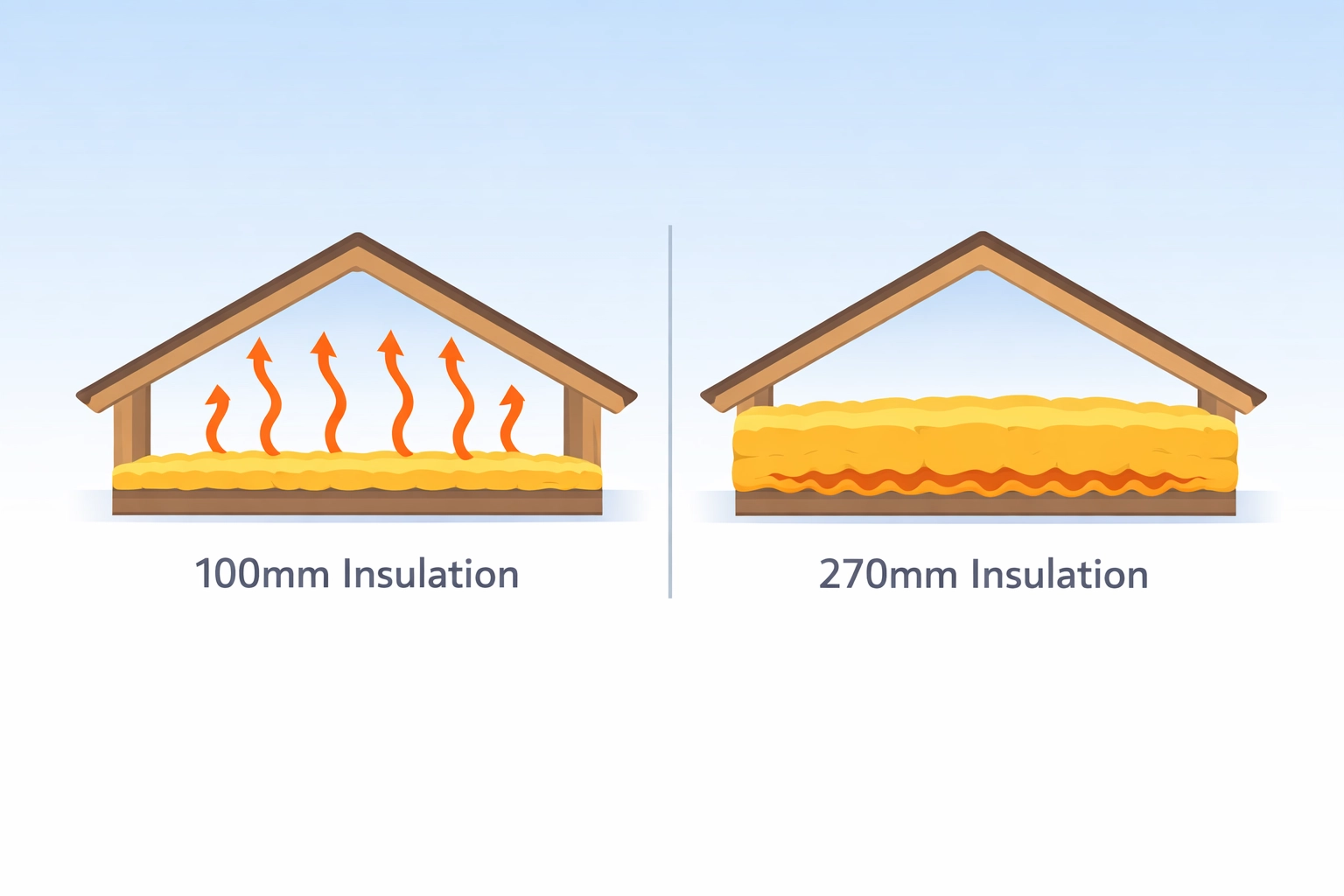
100mm of mineral wool typically achieves a U-value of around 0.28.
The modern 270mm standard hits a U-value of 0.15 or 0.16.
Mathematically, 270mm is twice as effective at stopping heat loss.
Think of it like wearing a thin t-shirt in a snowstorm.
It’s better than being naked, but you’re still freezing.
Adding that extra 170mm is like putting on a high-quality thermal coat.
Why 270mm is the Magic Number
The UK government and building experts didn't pick 270mm at random.
It is the point where performance and cost-effectiveness meet.
Beyond 270mm, you still get gains, but they start to diminish.
1. Building Regulations (Part L)
Current UK Building Regulations (Part L) demand high thermal efficiency.
While these often apply to new builds or major renovations, they set the pace.
The 270mm benchmark has actually been the standard since 2006.
If your insulation predates that, you are officially behind the times.
2. The 2026 Energy Landscape
Heating a home is more expensive than it was five years ago.
Energy price caps fluctuate, but the baseline remains high.
100mm of insulation allows roughly 25% of your heat to vanish through the roof.
Thickening that layer to 270mm slashes that loss significantly.
3. Carbon Footprint Reduction
A well-insulated home uses less gas or electricity.
This directly reduces your household carbon emissions.
Meeting the 270mm standard is the easiest way to "go green" without installing expensive tech.
The EPC 'C' Roadmap and Your Property Value
The Energy Performance Certificate (EPC) is becoming a vital document.
By 2026, the push for all UK homes to reach an EPC rating of 'C' is intensifying.
This is especially true for the rental market.
If you plan to sell or rent your property, 100mm insulation is a red flag.
An EPC assessor will note the thickness of your loft wool.
Thin insulation pulls your score down.
Low scores can deter buyers or force you to lower your asking price.
Upgrading to 270mm is a relatively low-cost way to boost your rating.
It shows prospective buyers that the home is maintained to modern standards.
You can learn more about this in our Property Sales & Investment section.

Is Your 100mm Insulation Actually "Bad"?
"Bad" might be a strong word, but "insufficient" is accurate.
There are three main reasons why 100mm is failing you right now:
- Heat Escape: It simply isn't thick enough to trap rising air.
- Material Degradation: Older 100mm layers often settle and thin out over time.
- Incomplete Coverage: Old installations often have gaps around the edges or pipes.
If your insulation is from the 90s, it might even be contaminated.
Dust, rodent droppings, or moisture can ruin its thermal properties.
In these cases, the 100mm you do have isn't even working at full capacity.
The Problem with the "Joist Level" Myth
For decades, homeowners believed insulation should stop at the top of the wooden joists.
Most joists in UK lofts are roughly 100mm deep.
This created a neat, flat surface that was easy to walk on.
However, modern standards require the insulation to be much higher than the joists.
This leads to a common dilemma: how do you use your loft for storage?
Many people make the mistake of squashing 270mm of wool down to fit under floorboards.
Never squash your insulation.
Insulation works by trapping air between its fibres.
When you compress it, you squeeze the air out.
Squashed 270mm insulation can perform worse than a healthy 100mm layer.
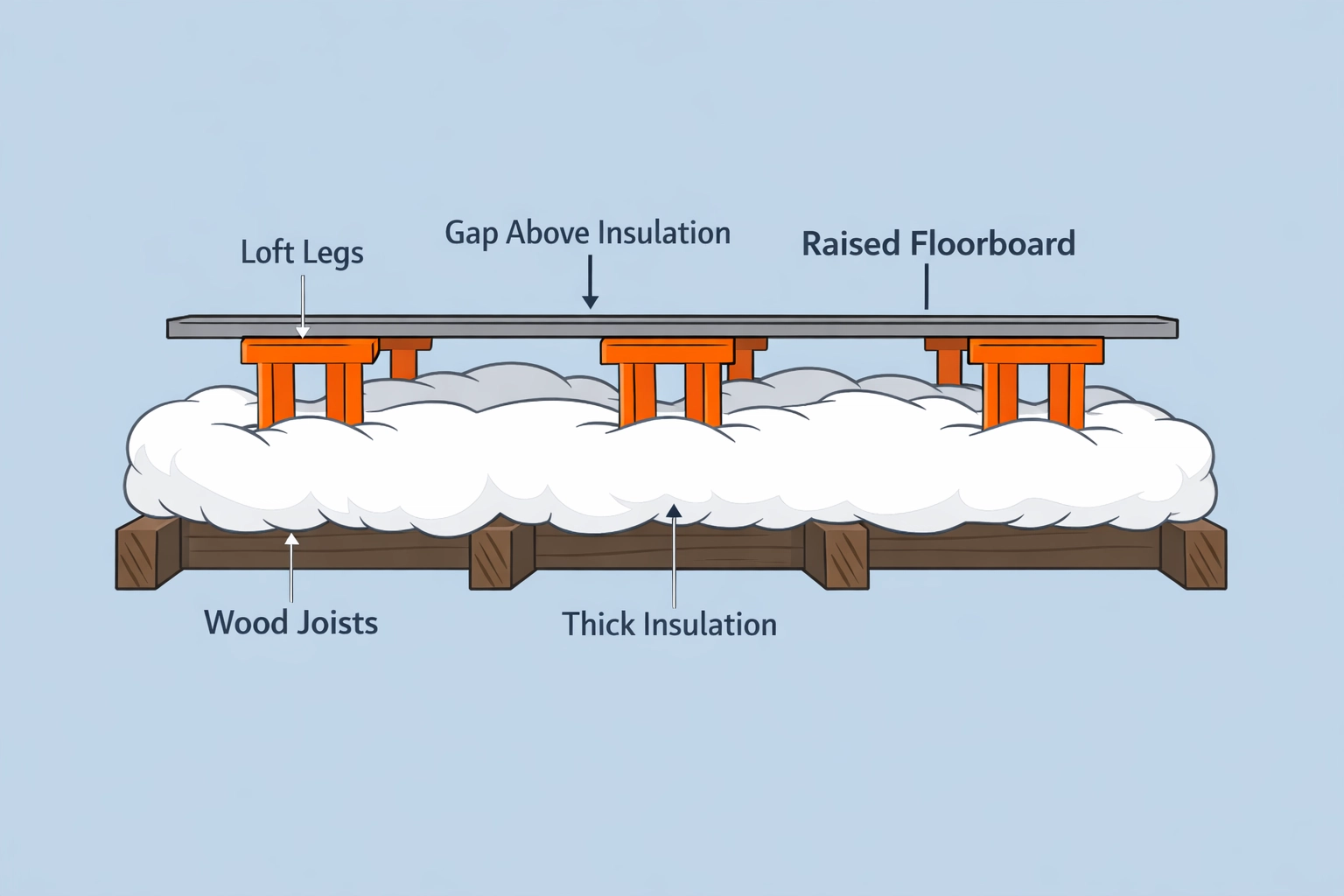
To solve this, we use "loft legs" or stilts.
These raise the floorboards above the full 270mm depth.
It keeps your storage space and your thermal efficiency intact.
Check out our guide on Practical Loft Solutions & Maintenance for more on this.
Can You Simply "Top Up" Your Insulation?
The good news is that you don't always need to start from scratch.
If your existing 100mm of insulation is dry and in good condition, we can "top it up."
We simply lay a new 170mm layer across the existing wool.
Crucially, the new layer is usually laid at a 90-degree angle to the joists.
This "cross-layering" method is highly effective.
It covers the wooden joists themselves, which can otherwise act as "thermal bridges" that leak heat.
However, if your old insulation is damp, moldy, or full of debris, it must go.
Adding new material over "bad" material traps moisture and leads to rot.
A professional survey is the only way to be sure.
You can Book Your Free Consultation to have us take a look.
Real Savings: What to Expect
Upgrading from 100mm to 270mm isn't just a regulatory checkbox.
It results in tangible savings on your monthly bills.
While every home is different, most homeowners see a noticeable drop in their heating requirements.
In a typical detached house, the savings can be upwards of £200–£300 per year.
Given the relatively low cost of a top-up, the upgrade often pays for itself within two or three winters.
After that, the savings are pure profit.
More importantly, the comfort levels in your home will change.
You will notice fewer drafts.
Upstairs rooms will stay warmer for longer after the heating goes off.
The "thermal mass" of your home increases, making it a more stable environment.

Why Professional Installation Matters in 2026
It is tempting to buy a few rolls of wool and do it yourself.
But loft insulation is more complex than it looks.
Ventilation is critical.
When you increase insulation to 270mm, your loft becomes much colder.
The heat from the house no longer warms the roof space.
This can lead to condensation and wood rot if the airflow is blocked at the eaves.
Electrical Safety.
Cables shouldn't be buried under thick insulation.
They can overheat.
Professional installers know how to safely route or clip cables to prevent fire risks.
Consistent Coverage.
Missing just 5% of the loft area can reduce the overall efficiency by 20%.
Professionals ensure every nook, cranny, and hatch is covered properly.
For more on safe practices, visit our Regulations & Building Standards category.
Final Thoughts
Is your 100mm loft insulation "bad"?
Technically, it’s outdated, inefficient, and likely costing you a small fortune.
By 2026 standards, it is simply not enough to protect your home from rising costs and stricter regulations.
Moving to the 270mm standard is a non-negotiable step for any responsible homeowner.
It future-proofs your property, secures your EPC rating, and keeps your family warm.
Don't wait for another winter of high bills.
Check your loft depth today.
If you can see the top of your joists, you need an upgrade.
Ready to see how much you could save?
Get A Quote today or Book Your Free survey with the ComfySeal team.
We'll help you hit that 270mm target the right way.